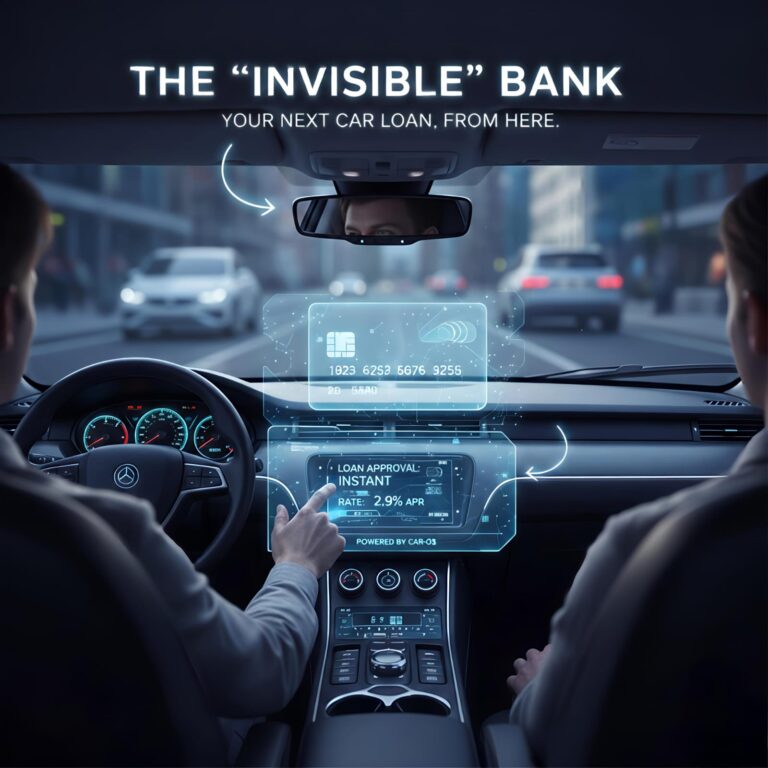
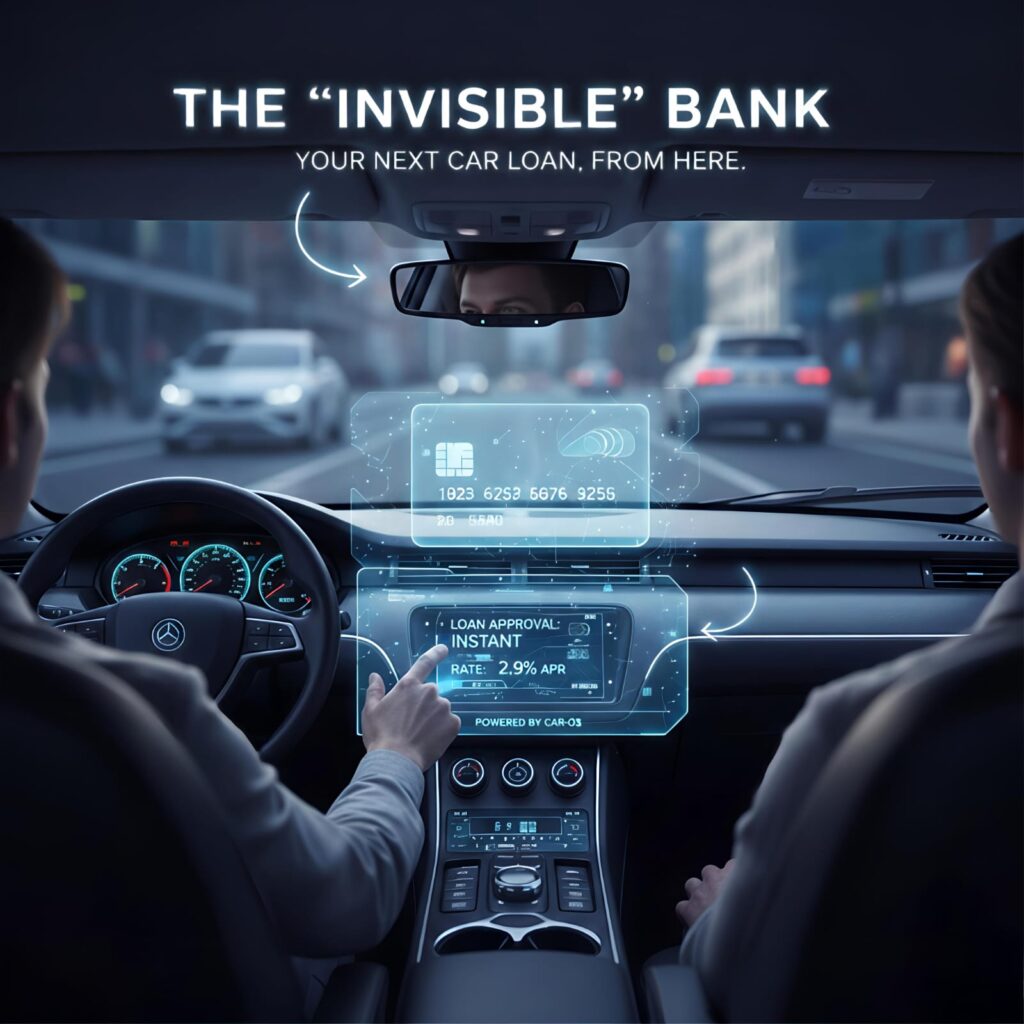
Imagine a scenario where the most powerful financial tool you own is not in your pocket, nor is it a plastic card in your wallet. Instead, it is parked in your driveway. While you sit in the driver’s seat, the engine hums silently, and a notification appears on the high-definition screen in front of you. By using a simple voice command and a biometric scan of your fingerprint on the ignition, you secure financing for your vehicle instantly. Consequently, the need for paperwork, waiting rooms, and bank managers has vanished forever.
This is the dawn of The Invisible Bank.
For over a century, the process of acquiring a car loan has been notoriously friction-heavy and manual. Traditionally, you would have to visit a brick-and-mortar branch or sit in a dealership’s finance office for hours. However, a seismic shift is currently reshaping the global economy. Embedded finance—the integration of financial services directly into non-financial products—is projected to exceed $7 trillion in transaction value by 2026. Furthermore, nearly 10% of all financial transactions in the US are now processed through these “invisible” layers. Consequently, your vehicle is evolving from a simple mode of transportation into a sophisticated, rolling financial hub.
In this exhaustive deep dive, we will explore exactly how The Invisible Bank works, why the traditional branch is facing extinction, and what this means for your future wealth.
Defining “The Invisible Bank” in the Automotive World
To understand the future, we must first define the concept. The Invisible Bank is not a new institution; rather, it is a technological layer. It represents the integration of financial services into non-financial environments. In the automotive sector, this means the car manufacturer (OEM) acts as the primary interface for the bank.
When you use The Invisible Bank, the financial transaction disappears into the background of the user experience. You don’t “go to the bank” to get a loan; instead, the loan comes to you exactly when you need it. This shift from “Digital Banking” to “Ambient Finance” means that services are always present but rarely seen.
The Convergence of Three Titans
This phenomenon is not happening by accident. Rather, it is the result of three massive industries colliding:
FinTech (Financial Technology): Agile startups are building APIs (Application Programming Interfaces) that allow any software to speak to banks in milliseconds.
AutoTech: Cars are now software-defined vehicles (SDVs) with 5G connectivity and massive processing power.
Big Data & AI: Real-time analytics allow lenders to assess risk instantly based on behavior, not just historical credit scores.
Therefore, the dashboard is no longer just for displaying speed and fuel levels. On the contrary, it is now a portal to The Invisible Bank, capable of executing complex financial contracts faster than a human could sign a single piece of paper.
The Death of the Physical Branch: A Data-Driven Exit
Historically, banks relied on physical proximity to acquire customers. If a bank branch was on your corner, you likely trusted them with your money. However, digital natives view physical branches as inconveniences rather than assets. They value speed and integration above all else.
Consequently, the traditional bank branch is becoming irrelevant in the auto loan journey. Why drive to a bank to ask for money to buy a car, when the car itself can offer you the money instantly? As of 2026, over 52% of auto loan originations are attributed to digital channels, representing a massive transition toward online and in-car platforms.
The Friction Factor
Consider the traditional workflow versus the new reality:
The Old Way: You research cars. Next, you visit a bank. After that, you fill out paper forms. Then, you wait 24 hours for approval. Finally, you take a check to the dealer and wait for verification.
The Invisible Bank Way: You select a car online or in-vehicle. Immediately, the car’s software verifies your identity via your smartphone. Subsequently, the dashboard displays a pre-approved loan offer. You tap “Accept.” You drive away.
The reduction in friction is absolute. Moreover, study after study shows that 75% of users choose embedded payments simply because of the convenience. Because The Invisible Bank eliminates the “middleman” steps, it captures the customer at the exact moment of highest intent.
How Dashboard Financing Actually Works: Under the Hood
You might be wondering, “How can a dashboard approve a loan?” It seems like magic, but it is actually a sophisticated dance of data. Here is the step-by-step mechanics of how The Invisible Bank operates under the hood.
1. Biometric Identity Verification
Security is paramount. Instead of showing a driver’s license to a loan officer, your car uses biometric authentication. This could be facial recognition via the driver monitoring system or a fingerprint sensor on the start button. Consequently, identity theft and fraud become significantly harder to execute.
2. API-Led Credit Decisioning
Once the car knows it is you, it sends an encrypted signal to a lending core. This is not a manual review. Instead, the software pings credit bureaus and alternative data sources instantly. In 2026, many lenders use “Agentic AI” to analyze millions of data points to flag anomalies and verify creditworthiness without the need for traditional credit-invisible populations to be excluded.
3. Dynamic Collateral Valuation
This is where The Invisible Bank shines. A traditional bank guesses the value of the car based on a generic “Blue Book” value. In contrast, the car knows its exact condition. It knows its VIN, its precise mileage, its service history, and its battery health. Therefore, the loan offer is based on 100% accurate asset data, drastically reducing risk for the lender.
4. Smart Contracts
The agreement isn’t a stack of paper. Rather, it is a digital smart contract stored on a secure ledger. When you tap “I Agree” on the dashboard, the contract executes immediately. Furthermore, funds move from the lender to the seller in real-time via Instant Payment rails.
The Trust Equation
In the world of digital finance, Trust (the ‘T’ in Experience, Expertise, Authoritativeness, and Trustworthiness) is the currency of the realm. Why would you trust your car with your financial data? The answer lies in the deep relationship between the driver and the brand.
Car manufacturers have spent decades building brand loyalty. You trust your car to keep you safe at 70 miles per hour. Therefore, extending that trust to financial transactions is a smaller psychological leap than trusting a random bank you have never visited.
The Authority of the Manufacturer
Furthermore, manufacturers possess unique “Authoritativeness” regarding the asset. A bank knows money; conversely, a car company knows cars. When a manufacturer like BMW or Tesla offers you a loan through their dashboard, they are leveraging their expertise in the vehicle’s lifecycle to offer you better terms. They know the car will last; therefore, they can offer a lower interest rate than a traditional institution.
The “Living” Loan: Dynamic Interest Rates
Perhaps the most revolutionary aspect of The Invisible Bank is the potential for dynamic financing. Traditional loans are static. You get a 5% interest rate, and it stays 5% for five years, regardless of how you drive.
The Invisible Bank changes this paradigm completely. Because the dashboard is constantly collecting telematics data, your loan could be “alive.”
Scenario A (High Risk): If you drive aggressively, skip maintenance, and rack up high mileage, the dashboard may notify you that your risk profile has increased. Consequently, your variable rate might tick up slightly to reflect the faster depreciation.
Scenario B (Low Risk): If you drive safely, charge the battery optimally, and keep the car in pristine condition, The Invisible Bank rewards you. As a result, your interest rate drops because the asset is maintaining its value better than expected.
This alignment of incentives encourages better driving and better car care. Simultaneously, the bank, the manufacturer, and the driver all win in this ecosystem.
Beyond the Loan: The Wallet on Wheels
Financing the purchase is just the beginning. Once The Invisible Bank is integrated into your dashboard, the vehicle transforms into a digital wallet for all mobility-related expenses. Essentially, the car obtains its own digital identity and “credit card.”
Embedded Insurance
Currently, you buy a car, then you have to call an insurance company. The Invisible Bank merges these steps. Not only does the dashboard offer you insurance instantly, but it also offers “Pay-How-You-Drive” (PHYD) insurance. Because the car proves to the insurer that you are a safe driver, you secure premiums that are 20-30% lower than traditional policies.
Frictionless Refueling and Charging
Imagine pulling up to an EV charging station. Usually, you have to fumble with an app, a credit card, or a dongle. With The Invisible Bank, the car talks to the charger through “Plug and Charge” technology.
First, you plug in.
Next, the charger recognizes the car’s unique digital ID.
Then, The Invisible Bank processes the payment in the background.
Finally, you unplug and leave.
In-Car Upgrades (Feature on Demand)
Manufacturers are moving toward “Feature on Demand” models. Do you want heated seats for the winter months? Do you need a self-driving software upgrade for a long road trip? You can “rent” or “finance” these features directly through the dashboard. Consequently, The Invisible Bank handles the micro-transactions seamlessly without requiring you to pull out your wallet.
The Economic Shift: OEMs Becoming FinTechs
This shift is not just about consumer convenience; rather, it is about survival for car manufacturers. The profit margins on selling hardware (metal cars) are slim. However, the margins on financial services and software are huge.
By controlling The Invisible Bank, car companies like Tesla, Ford, and Toyota stop handing over their customers to Chase or Wells Fargo. Instead, they keep the customer in their own ecosystem. They capture the interest revenue, the transaction fees, and the valuable data.
Consequently, we are seeing a hiring spree in the automotive sector. They aren’t just hiring mechanical engineers anymore; they are also hiring bankers, data scientists, and cybersecurity experts. Ultimately, the car company of the future is essentially a bank that happens to build cars to acquire its customers.
The Security Paradox: Is It Safe?
With great connectivity comes great risk. If your car is your bank branch, is it susceptible to a bank robbery? In the digital age, a robbery doesn’t involve a mask and a gun; instead, it involves a laptop and code.
The Cybersecurity Fortress
Critics rightly point out that cars have been hacked before. However, the financial layer of The Invisible Bank operates on a separate, secure partition of the vehicle’s operating system. Manufacturers use “Defense in Depth” strategies:
Tokenization: Your actual financial details are never stored locally on the dashboard. Instead, the system uses encrypted tokens.
Hardware Security Modules (HSM): Dedicated chips prevent tampering with the software.
Over-the-Air (OTA) Updates: If a threat is detected, the manufacturer can patch the entire fleet of cars instantly over the internet.
While no system is 100% unhackable, the security protocols for The Invisible Bank are often more rigorous than those of legacy retail banks. This is simply because the stakes involve a 4,000-pound moving object.
The Future: When the Car Pays for Itself
Let’s look ten years down the road to 2030 and beyond. The ultimate evolution of The Invisible Bank is the autonomous economy.
Imagine a world where you own a self-driving car. During the day, while you work, your car leaves the parking lot and operates as a taxi. It picks up passengers and collects fares.
Where does that money go? It goes into the dashboard wallet. Then, The Invisible Bank uses those earnings to pay the car loan automatically. Subsequently, it pays for its own charging and insurance.
In this scenario, the car is no longer a liability; instead, it is an asset that manages its own balance sheet. You are not the payer; rather, you are the shareholder. This reality is only possible because of the financial plumbing we are building today.
Conclusion: The Branch is Closed, Long Live the Dashboard
The transition is undeniable. We are witnessing the dismantling of the traditional auto loan process. The friction, the paperwork, and the waiting are being replaced by data, speed, and software.
The Invisible Bank is not just a feature; on the contrary, it is a fundamental shift in how we view ownership. Your car is becoming an active participant in your financial life. It negotiates for you, it pays for you, and it secures funds for you.
For the consumer, this means an era of unprecedented convenience. For the banks, it means adapt or die. And for the dashboard, it means taking center stage as the most important screen in your financial portfolio. The next time you sit in a new car, look at that screen. You aren’t just looking at a GPS; instead, you are looking at your new bank manager.
Key Takeaways
Autonomous Cars could eventually manage their own balance sheets, paying off their own loans through ride-sharing revenue.
Embedded Finance will exceed $7 trillion by 2026, moving banking into everyday products.
The Invisible Bank utilizes biometrics and APIs for instant, paperless car loans.
Dynamic Loans adjust interest rates in real-time based on your driving behavior and car maintenance.
Vehicles as Wallets allow for frictionless payments for charging, parking, and insurance.
About the Author