Imagine a dry, cracked landscape in a remote corner of Rajasthan. For years, local farmers struggled with failing monsoons and high-interest debt from village moneylenders. Suddenly, a community-led watershed project transforms the soil, while a local women’s cooperative secures a low-interest loan to start a dairy processing unit. This transformation is the heartbeat of NABARD (National Bank for Agriculture and Rural Development) – Focuses on rural finance as the primary catalyst for changing the face of rural India.
Since its inception on July 12, 1982, NABARD has evolved from a mere refinancing agency into a global model for rural development. By replacing the agricultural credit functions of the RBI, it created a dedicated channel for grassroots prosperity. Consequently, it now manages assets worth trillions of rupees, all directed toward one goal: fostering a self-reliant rural economy.
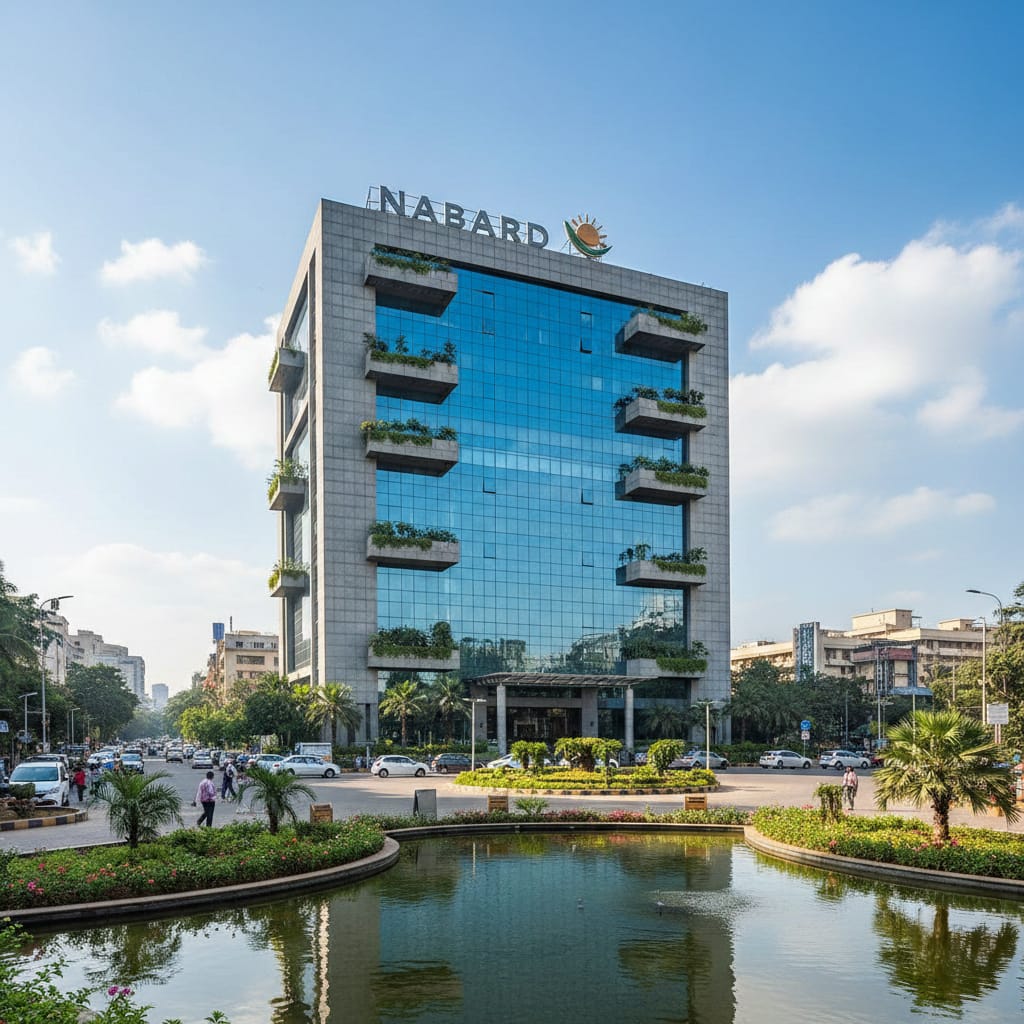
What is NABARD? Understanding the Apex Body
At its core, NABARD is India’s apex development bank. While commercial banks focus on urban centers, NABARD (National Bank for Agriculture and Rural Development) – Focuses on rural finance to bridge the gap between financial policy and the actual farmer in the field. It operates under the complete ownership of the Government of India, ensuring that its mission remains aligned with national welfare.
Furthermore, NABARD does not usually interact with individual farmers directly at a teller window. Instead, it acts as the “banker’s bank” for the rural sector. It provides the necessary liquidity and policy framework to Regional Rural Banks (RRBs) and Cooperative Banks. Therefore, when you see a local cooperative bank thriving, it is often because NABARD is providing the invisible support system behind it.
The Mission and Vision
The vision is clear: to be the development bank of the nation for fostering rural prosperity. In contrast to profit-driven entities, NABARD’s mission is to promote sustainable and equitable agriculture. It achieves this through participative financial and non-financial interventions.
How NABARD Transforms the Rural Credit Landscape
One might wonder how a single institution can influence millions of lives. The secret lies in its multi-layered approach to credit delivery. Consequently, the bank uses three primary “levers” to move the rural economy: Financial, Developmental, and Supervisory.
1. The Financial Lever (Refinance)
NABARD provides massive amounts of refinance to financial institutions. For instance, in the 2023-24 financial year, it disbursed over ₹1.5 lakh crore for short-term and long-term financing.
Short-Term Loans: These are typically for “Seasonal Agricultural Operations” (SAO). They help farmers buy seeds and fertilizers.
Long-Term Loans: These focus on investment credit. If a farmer wants to buy a tractor or install a solar pump, the bank provides the long-term funds to make it happen.
2. The Developmental Lever
Beyond money, NABARD builds institutions. It pioneered the Self-Help Group (SHG) Bank Linkage Programme, which has now become the world’s largest microfinance movement. By organizing rural women into groups, NABARD turned “social collateral” into financial credit.
3. The Supervisory Lever
To ensure that rural banks stay healthy, NABARD conducts statutory inspections of RRBs and Cooperative Banks. Consequently, this maintains public trust in the rural banking system.
Key Schemes: Making “Rural Finance” Work for You
If you are a rural entrepreneur or a student of finance, understanding specific schemes is crucial. NABARD (National Bank for Agriculture and Rural Development) – Focuses on rural finance through targeted programs that address specific pain points in the supply chain.
The Rural Infrastructure Development Fund (RIDF)
Infrastructure is the backbone of growth. Consequently, the RIDF was created to fund state governments for projects like rural roads, bridges, and irrigation.
Benefit: When a new bridge is built in a village, the “market-to-farm” distance decreases.
Impact: This reduction in travel time directly increases the shelf life of perishable goods like milk and vegetables.
Farmer Producer Organisations (FPOs)
A single farmer has no bargaining power. However, when 500 farmers join forces, they become a market force. NABARD supports the formation of FPOs by providing initial grants and credit guarantees. Furthermore, it helps these groups set up processing units, allowing them to sell “branded” flour instead of “raw” wheat.
The Kisan Credit Card (KCC)
The KCC is perhaps the most famous product associated with NABARD’s influence. It provides a revolving credit facility. Therefore, a farmer doesn’t need to apply for a new loan every season; they simply use their card like a credit card for all farm-related expenses.
Case Study: The “Wadi” Model Success
To understand the real-world impact of NABARD (National Bank for Agriculture and Rural Development) – Focuses on rural finance, look at the “Wadi” (small orchard) project in the tribal belts of Gujarat and Maharashtra.
The Problem: Tribal families often relied on rain-fed crops, which failed during droughts, leading to forced migration to cities.
The Intervention: NABARD provided grants and technical support to convert one acre of wasteland into an orchard (Wadi) for each family. They planted fruit trees like Mango and Cashew, alongside timber trees on the borders.
The Result:
Income Stability: Within five years, families saw their annual income rise by 300%.
Environmental Impact: What was once barren land became a green carbon sink.
Social Change: Migration rates dropped by 80% as families found sustainable livelihoods at home.
NABARD in 2026: The Digital and Green Revolution
As we move into the mid-2020s, the focus of NABARD (National Bank for Agriculture and Rural Development) – Focuses on rural finance has shifted toward two modern pillars: Technology and Climate Resilience.
1. The Rise of “Agri-Stack” and Digital IDs
NABARD is now leading the integration of “Smart Farmer Identification Cards.” These cards use blockchain-lite technology to store a farmer’s land records, credit history, and subsidy eligibility. Consequently, this eliminates the “middleman” and ensures that benefits reach the intended recipient instantly.
2. Climate-Smart Agriculture
Climate change is no longer a future threat; it is a present reality. Therefore, NABARD has launched the Green Lending Facility (NGLF). This fund provides concessional interest rates for projects that involve:
Solar-Powered Cold Storages: Reducing dependency on the failing rural power grid.
Micro-Irrigation: Ensuring “more crop per drop.”
Organic Farming: Helping farmers transition away from expensive chemical fertilizers.
3. Supporting the Agri-Startup Ecosystem
Through its venture capital arm, NABVENTURES, the bank is now funding young entrepreneurs. If a student from an IIT or a rural college develops a drone for precision spraying, NABARD provides the seed capital. This shift shows that the bank is no longer just “traditional”; it is becoming a tech-forward institution.

Challenges Facing Rural Finance Delivery
Even with such a robust system, hurdles remain. It is important to look at these with intellectual honesty to understand the full picture.
The Credit Gap: Despite massive disbursements, nearly 30% of small and marginal farmers still lack access to formal credit.
Financial Literacy: Many villagers are still wary of “paperwork.” Consequently, they often revert to local lenders who, while expensive, offer immediate “no-questions-asked” cash.
Debt Waivers: Frequent political promises of loan waivers often disrupt the “credit culture.” Farmers might stop repaying loans in anticipation of a waiver, which hurts the long-term health of cooperative banks.
How to Leverage NABARD Initiatives: A Step-by-Step Guide
Whether you are an NGO worker, a student, or a farmer, you can benefit from NABARD’s resources. Here is how you can tap into the system.
Step 1: Identify the Local DDM
Every district in India has a District Development Manager (DDM) from NABARD. They are the local “face” of the bank. Furthermore, they maintain the “Potential Linked Credit Plan” (PLP) for your area. Visit them to understand which crops or businesses are being incentivized in your specific district.
Step 2: Use the NABSKILL Portal
If you are looking for vocational training, the NABSKILL portal is your best friend. It lists thousands of NABARD-funded training programs—from mobile repairing to advanced organic farming—offered through various partners.
Step 3: Form or Join a JLG (Joint Liability Group)
If you don’t have land to show as collateral, don’t worry. A Joint Liability Group allows 4 to 10 people to take a loan based on “mutual guarantee.” Essentially, the group’s reputation acts as the security.
The Strategic Importance of NABARD for India’s GDP
Agriculture contributes roughly 15-18% to India’s GDP, but it employs nearly half the workforce. Consequently, any growth in this sector has a massive “multiplier effect” on the rest of the economy. NABARD (National Bank for Agriculture and Rural Development) – Focuses on rural finance to ensure that this 18% remains stable and productive.
When rural India has money, they buy tractors, motorcycles, and consumer goods. This demand fuels the manufacturing sector in cities. Therefore, NABARD isn’t just a “rural bank”; it is a vital organ of the entire Indian economic body.
Summary of NABARD’s Impact (Table)
| Feature | Description | Impact |
| Establishment | 1982 via CRAFICARD Committee | Specialized focus on rural needs. |
| Ownership | 100% Government of India | High trust and policy alignment. |
| Core Product | Refinance to RRBs & Cooperatives | Ensures liquidity in rural areas. |
| Social Success | SHG-Bank Linkage | Empowered 140+ million households. |
| Modern Pivot | Green Finance & Agri-Tech | Future-proofing the farm sector. |
Final Thoughts: The Unseen Architect of Prosperity
In conclusion, NABARD (National Bank for Agriculture and Rural Development) – Focuses on rural finance not as an end in itself, but as a means to dignity for the Indian farmer. It is the unseen architect behind the new warehouse in your village, the solar pump on your neighbor’s farm, and the empowerment of women in every local SHG.
As the world moves toward sustainable development, NABARD’s model of “finance with a soul” provides a blueprint for other developing nations. By combining hard financial discipline with a deep empathy for the rural landscape, it remains the most significant force in India’s journey toward a $5 trillion economy.
About the Author