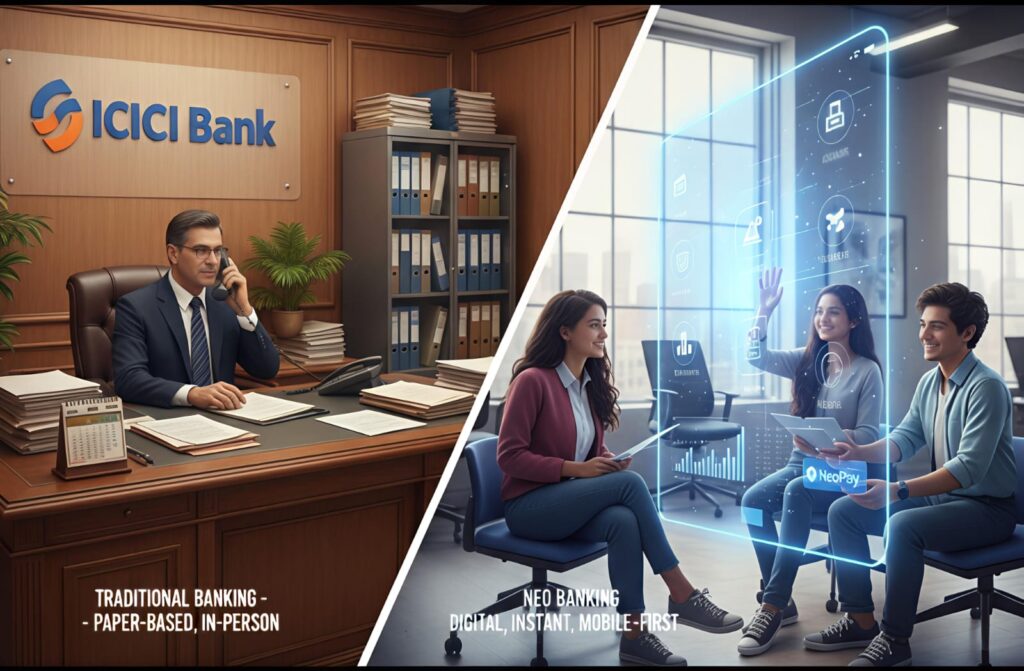
The financial landscape of 2026 looks nothing like the world we inhabited just five years ago. Specifically, the fierce competition in the Neobanks vs. ICICI arena has fundamentally altered how we perceive money management. Consequently, the “branchless” dream is no longer a futuristic concept but a daily reality for millions of digital-first users. While traditional giants have historically dominated the market, the rise of sleek, agile competitors has forced a reckoning in the corridors of traditional power.
Historically, trust was built on granite pillars and marble floors. In contrast, the 2026 user values high-speed API calls and invisible interfaces over physical proximity. Furthermore, as the Reserve Bank of India (RBI) implements its strictest digital guidelines yet, the line between a “tech company that does banking” and a “bank that does tech” has blurred almost to the point of extinction.
1. The Branchless Explosion: 2026 Market Dynamics
By the start of 2026, the global neobanking market has surged toward a staggering $395 billion valuation. Consequently, India has emerged as a primary battleground for this revolution. Neobanks like Jupiter, Fi, and Niyo are no longer just “add-on” apps for teenagers. Instead, they have matured into robust financial hubs that manage salaries, investments, and insurance for the tech-savvy workforce.
The Death of the Queue
In the past, opening a bank account involved a stack of papers and a mid-day visit to a dusty branch. Furthermore, the dreaded “lunch break” of the bank staff often stalled consumer progress. Today, the branchless model has annihilated these friction points. Consequently, a user can now complete a full Video-KYC and start transacting in under three minutes while sitting in a cafe. This speed is the primary weapon in the Neobanks vs. ICICI war.
Cost Efficiency as a Weapon
Neobanks operate without the massive overhead of physical real estate and thousands of tellers. Consequently, they can afford to offer higher interest rates on savings—often touching 7% in specific tiers—while traditional banks struggle to keep pace. Furthermore, the absence of “hidden” maintenance fees has made neobanks the darling of the gig economy and freelance professionals.
2. ICICI’s Digital Fortress: The Giant Awakens
It would be a grave mistake to assume that traditional banks are fading into irrelevance. Furthermore, ICICI Bank has proven to be remarkably resilient. By 2026, ICICI has successfully pivoted from a “bank with an app” to a “digital platform with branches.” Their iMobile Pay app now serves over 160 million transactions per day, a volume that many neobanks can only dream of reaching.
The “Super App” Strategy
Consequently, ICICI has integrated over 400 different services into its digital ecosystem. Whether you need to pay a utility bill, book a flight, or manage a complex portfolio of international stocks, the ICICI platform handles it within a single interface. Furthermore, the bank has embraced an “Open Architecture” model. This means even non-ICICI account holders can use their UPI and payment services, effectively turning the bank into a fintech service provider.
The Human Safety Net
Furthermore, ICICI understands that for high-stakes financial decisions, human intervention remains a valuable commodity. While a neobank might use an AI chatbot to resolve a missing ₹500 transaction, ICICI offers a dedicated relationship manager for complex home loan disputes or corporate credit lines. Consequently, the Neobanks vs. ICICI debate often boils down to a choice between “efficiency” and “assurance.”
3. Regulatory Shifts: The 2026 Compliance Wall
The year 2026 has brought a tsunami of new regulations from the RBI. Furthermore, these rules have leveled the playing field significantly. As of January 1, 2026, all digital banking services require explicit authorization under new cybersecurity frameworks. Consequently, neobanks—which previously operated in a “gray area” via partnerships—must now adhere to the same rigorous standards as ICICI Bank.
The Digital Banking Units (DBUs)
The government’s push for Digital Banking Units has allowed traditional banks to set up mini, paperless “hubs” that mimic the neobank experience. Furthermore, the new liquidity norms for digital deposits mean that banks must maintain higher buffers for money that can be moved with a single tap. Consequently, the cost of doing business for neobanks has risen, narrowing the price gap between them and traditional giants.
4. Comparing the User Experience: A Direct Rivalry
To truly understand the Neobanks vs. ICICI conflict, we must look at the granular details of the daily user experience. In 2026, the differences are subtle but significant.
| Feature Segment | Neobanks (Jupiter, Fi, etc.) | ICICI Bank (iMobile Pay) |
| Onboarding | 100% Mobile; Instant Virtual Card. | Hybrid; Video-KYC with Physical Backup. |
| App Performance | Zero-lag, Minimalist, Gamified. | Feature-rich, but occasionally cluttered. |
| Lending Speed | Instant “Nano-loans” based on data. | Comprehensive loans (Home/Auto) in hours. |
| Customer Support | 24/7 AI-Chat with Persistent Threads. | Chat, Phone, and Branch support. |
| Wealth Management | Direct Mutual Funds & Crypto-links. | Full FD/RD, Demat, and Insurance suites. |
Furthermore, neobanks excel at “financial wellness.” They use AI to nudge you when you spend too much on dining or suggest saving ₹10 every time you order on a food app. In contrast, ICICI focuses on “wealth preservation,” offering sophisticated tools for tax planning and retirement that neobanks are only just beginning to develop.
5. The AI Factor: Personalized Banking in 2026
In 2026, banking is no longer reactive; it is predictive. Furthermore, both sides of the Neobanks vs. ICICI divide are using Generative AI to stay ahead.
Neobanks: The Data Natives
Neobanks treat data like oxygen. Consequently, they analyze your transaction patterns to offer “pre-approved” credit exactly when you are at an electronics store. Furthermore, their AI-driven “Smart Pots” automatically move money into high-yield savings based on your upcoming bill cycles. This level of hyper-personalization makes the user feel like the bank is a personal assistant rather than a cold institution.
ICICI: The Institutional Brain
However, ICICI uses AI for “Preventive Security” and “Global Insights.” Their systems can detect a fraudulent transaction in milliseconds by comparing it to millions of global patterns. Furthermore, their AI assistant, iPal, has evolved into a sophisticated financial consultant. Consequently, it can explain the tax implications of a stock sale or help you rebalance your portfolio with a simple voice command.
6. Trust, Security, and the “Too Big to Fail” Sentiment
Despite the brilliance of neobank interfaces, the “Trust Factor” remains a significant hurdle. Furthermore, in 2026, users are increasingly wary of cybersecurity threats. Consequently, the 70-year legacy of ICICI Bank provides a psychological comfort that a five-year-old startup cannot match.
The Safety of Tradition
If a neobank’s partner bank faces liquidity issues, the app might freeze for days. In contrast, a systemic giant like ICICI is backed by massive capital reserves and government-mandated “too big to fail” protocols. Furthermore, the physical branch acts as a “panic button.” If your phone is stolen and your account is compromised, walking into an ICICI branch with a physical ID provides a level of immediate resolution that an email support ticket simply cannot provide.
The Security of Innovation
However, neobanks argue that they are actually more secure because they are not weighed down by “Legacy Systems.” Traditional banks often run on old codebases that are harder to patch. In contrast, neobanks use cloud-native, microservices architecture. Consequently, they can deploy security patches in minutes across their entire user base. Furthermore, features like “instant card freeze” and “dynamic CVVs” were pioneered by neobanks before being adopted by ICICI.
7. The Freelance and SME Revolution
The biggest victory for neobanks in the Neobanks vs. ICICI war has been in the Small and Medium Enterprise (SME) sector. Historically, traditional banks ignored the needs of freelancers and micro-entrepreneurs. Consequently, opening a business account at a traditional bank was a bureaucratic nightmare involving shop licenses and physical inspections.
Neobanks like Open and RazorpayX changed the game. Furthermore, they integrated payroll, GST filing, and invoicing directly into the banking dashboard. In 2026, a freelance graphic designer can manage their entire business finances from the same app they use to buy groceries. This “Utility-First” approach has successfully captured a massive segment of the Indian economy that felt underserved by the traditional banking hierarchy.
Is the Branchless Dream Finally Winning?
As we evaluate the state of banking in 2026, the winner depends entirely on your definition of “beating.”
Furthermore, if we look at Innovation and Customer Acquisition, the branchless dream is winning. Neobanks are capturing the youth at a rate that traditional banks struggle to match. Consequently, they are defining the “UI/UX” standards for the next generation. For a 21-year-old in 2026, a “bank” is an icon on their phone, not a building on the street.
However, if we look at Total Assets and Depth of Relationship, ICICI Bank remains the champion. Furthermore, the “Branchless” dream has ironically forced ICICI to become a better version of itself. Consequently, while neobanks have taken the lead in the “daily wallet” space, ICICI still controls the “life-long wealth” space.
Future Outlook: What Happens in 2027?
The trajectory suggests that the Neobanks vs. ICICI rivalry will transition into a “Co-opetition” model. Furthermore, we are already seeing ICICI acquire or deeply partner with smaller neobanks to stay agile. Consequently, the “branch” of the future might not be a place where you deposit cash, but a “high-tech lounge” for financial consulting and complex problem-solving.
The Convergence of Models
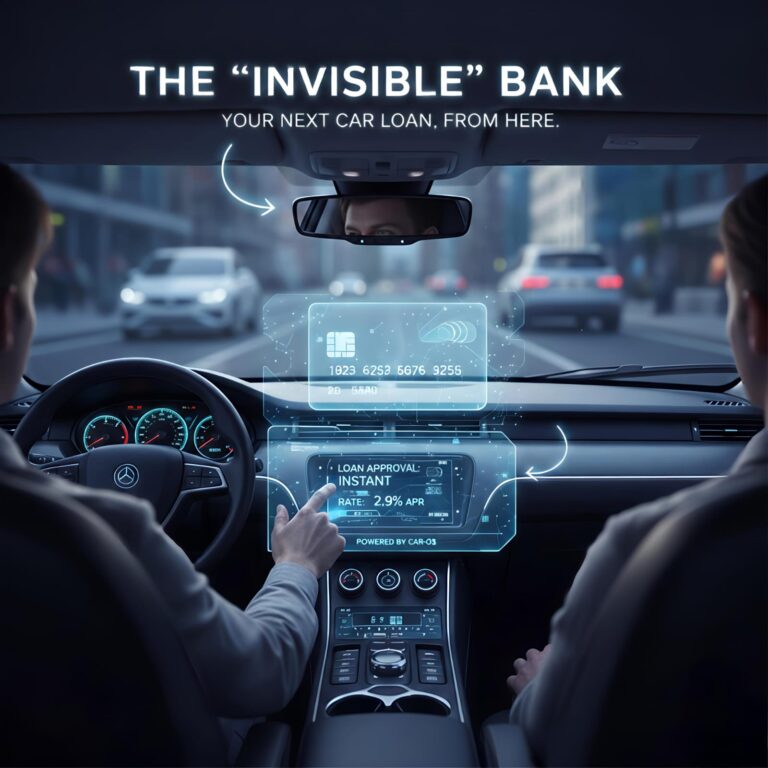
Traditional banks will continue to shed their physical weight, closing smaller branches and digitizing 99% of their operations. In contrast, neobanks will seek more stability, perhaps even opening “Experience Centers” in major cities to build physical trust. Furthermore, the “Branchless” dream will evolve into “Invisible Banking,” where your money management happens automatically in the background of your life.
Conclusion: Making the Right Choice for Your Money
Ultimately, the Neobanks vs. ICICI battle has empowered you, the consumer. You are no longer a prisoner of local geography or limited banking hours. Consequently, you have the freedom to choose a platform that aligns with your specific financial goals and tech-comfort level.
Go Branchless (Neobank) if you value speed, zero fees, and advanced budgeting tools. It is perfect for daily spending, travel, and early-stage investing.
Stay Traditional (ICICI) if you need a full-spectrum financial partner for loans, complex wealth management, and the security of a physical presence.
Furthermore, in 2026, most savvy users choose both. Consequently, they use a neobank for their “pocket money” and daily transactions, while keeping their long-term savings and home loans with a giant like ICICI. This hybrid approach ensures you get the best of both worlds—the speed of the future and the stability of the past.
Step-by-Step: How to Transition to a Hybrid Banking Model
Evaluate Monthly: Consequently, review which app you enjoy using more and adjust your balances accordingly.
Analyze Your Fees: Look at your last three months of ICICI statements for hidden charges.
Test a Neobank: Open a zero-balance account with a reputable neobank like Jupiter or Fi.
Move “Active Cash”: Transfer your monthly spending budget to the neobank to take advantage of budgeting tools.
Keep the “Core”: Retain your ICICI account for EMIs, salary credits, and long-term FDs to maintain your credit history.
About the Author